Wednesday, 6 July 2011

Skye, Scalpay and the Raasay Dolphins. Part 3.

Part 3, Scalpay, to Clachan on Raasay. Full selection of dolphin pictures.
It was another fine morning. As we broke camp the cuckoo bid us farewell as we started to paddle across Caol Mor towards the SW corner of the Island of Raasay. The wind and wave increased slightly as we made the crossing. However, after reaching Rubha na Cloiche the conditions eased and we had a following breeze that pushed us on towards Clachan, where we would visit the Raasay Outdoor Centre and perhaps have lunch.
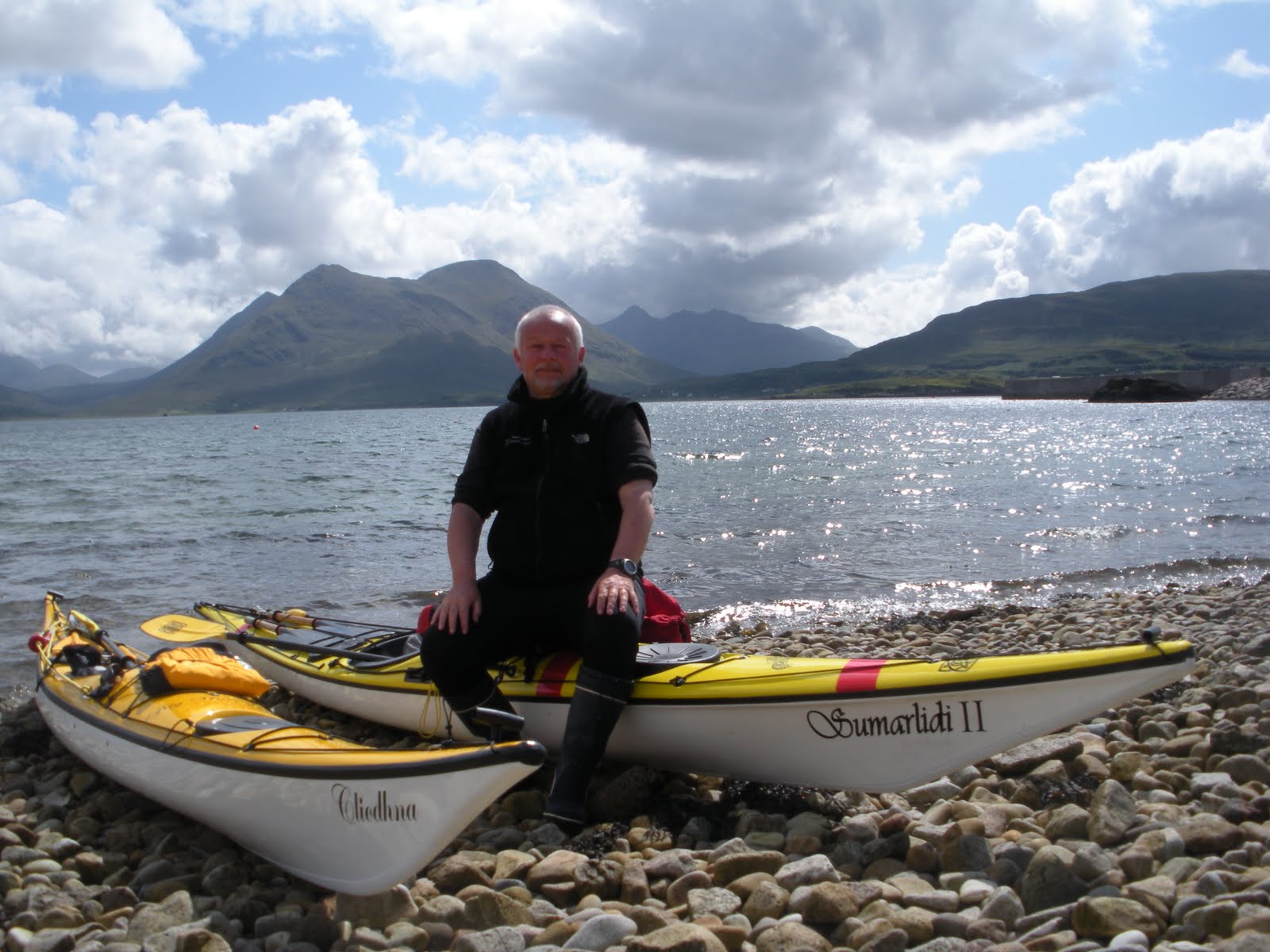
Jim and the landing site at Clachan on the Island of Raasay.The Red Cuillin dominate the views to the south.
The new pier at Clachan, Raasay.


One of a pair of mermaids on the embattlements at Clachan.


Ready to get back on the water.


The Island of Raasay has a welcoming atmosphere about it, and I will have to visit it again for an extended stay.
The weather was now superb with a light warm breeze and sun. As we passed the end of the pier we were greeted to a wonderful sight as three dolphins broke the surface of the sea heading towards us. I asked Jim to raft up quickly hoping to get the classic picture of these magnificent creatures rolling on the surface dorsal fins showing. However, what happened over the next 30 minutes was truly unbelievable. The experience of a lifetime!!!

I will let the pictures tell the story.


The middle dolphin that is rolling has a wound on its back with a discharge or growth.


A very close encounter. Fantastic.


Thechildren from the outdoor centre get a surprises visit they will never forget.
The pod move out into open water.

David Ardrey


Skye, Scalpay and Raasay. Part 2.

Part 2, Ardnish to North Scalpay.
Finally the weather had broken. I unzipped the tent after a good night’s sleep to the welcoming sight of the sun, blue skies and a calm blue sea. The seals that had been patrolling just of the shoreline since we had arrived were still there waiting to escort us off their territory. So breakfast was finished and it was time to leave our skerrie and head for Broadford on the east coast of Skye. As prearranged David C would leave us at Broadford. After lunch Jim and myself, helped by a following breeze headed through Caolas Scalpay and hugged the attractive west coast of the Island of Scalpay. To our delight we encountered several otters (two otters had pups with them) as we paddled along the coast of Scalpay. As we paddled north we saw many herons, and as we neared Camas na Geadaig we spotted a heard of red deer moving over the hillside on Scalpay.
As we put the tents up at Camas na Geadaig a cuckoo began to call, high overhead two ravens harried a golden eagle, and three seals arrived in the bay. Their bay!!
Camas na Geadaig, NW shoulder of Scalpay. Skye's Red Cuillin Hills in the background

Jim reflecting on the days paddle.
The evening glow.Views across the bay to the Island of Raasay.


A contented kayaker.


I lay looking out of the tent door, drinking tea and enjoying the views of the southern coast of the Island of Raasay. The twilight lingered on as seals snorted close to the shore, otters and herons hunted in the bay. When I did eventually slip into my sleeping bag the two streams that run into the bay gently bib me good night, as the sound of running water faded and faded, ZZZZZZZZZ.


David Ardrey.

Skye, Scalpay and Raasay. Part 1.

After travelling up from the central belt of Scotland we camped at Reraig campsite at Balmacara Bay on the mainland a few miles from the Skye Bridge. There was a large reception of midges to welcome us as we put the tents up, and they also bid farewell to us as we quickly took down the tents the next morning. Breakfast was postponed and soon we were passing over the Skye Bridge to the launching site at Kyleakin on Skye.
Packing the kayaks at Kyleakin.There is ample parking here to leave the cars.


Cliodhna ready to go.


With the weather forecast of S/SE winds, possibly veering S/SW 4 to 5 over the next few days we would be paddling part of the east coast/Islands off the east coast of Skye depending on the weather conditions. Soon the three of us: Jim B, David C and myself were passing under the Skye Bridge on our adventure. The further along the coast we paddled the more the wind increased and the weather deteriorated. Ardnish Point came into view and as the squals further increased it was decided that we would stop for lunch soon. A sandy skerrie beckoned us as we slogged towards it, escorted by seals and a few pups. By the time we had reached the small beach it had been decided that if the weather did not improve we just might be camping on the skerrie tonight if there were suitable pitches for the tents. As it ended up we would be camped on the skerries two nights. However, the longer we stayed here the more of her secrets showed us.
Being a bit of a romantic I opted to camp on a sandy plateau above the spring water mark.

Jim and David C's pitch.


Although the sand looks like coral it is in fact calcified seaweed.The coral looking type beaches are made up from sun bleached Red Macro algae which when alive contain or secrete calcium.

Oyster Catchers nest and eggs.
Plant life on the skerrie.

Fossil: Ammonite ? The sandstone slabs held many remnants of the past.
The weather breaks. Good news for tomorrow.
David Ardrey.


Monday, 4 July 2011

Dolphins off the Island of Raasay

Although every sea kayaking trip is special in its own right, every once in a while something happens that makes that particular trip just that extra bit special.
Checking us out.
Follow us
The show begins.
A Close encounter.
Children from the Raasay Outdoor Centre receive a visit that they will remember for a life time.


This was only part of a trip to Skye, Scalpay and Raasay. I will post a full trip report in parts with the complete set of dolphin pictures.


See you soon.


David A

Tent Review: Coleman Phad 3.

Coleman Phad 3.
This was the first opportunity I had to try the tent over several days on an extended kayaking trip. There were some heavy showers of rain over the first few days and the tent inner stayed completely dry, which was reassuring. The gap between the inner tent wall and the wall of the flysheet was fine. The adjustable vents on the flysheet also helped to reduce condensation on the underside of the flysheet. The structure and design of the tent against the wind was not really challenged during the trip as the wind never rose above beaufort scale 6. The porch, as hoped was more than big enough to handle my wet kit in and cook in when the weather deteriorated. The inner tent although big enough for me to sleep in would not be suitable for anyone who was tall. The time to erect the tent decreased throughout the trip. Although the groundsheet felt thin and vulnerable, there was no, problems with it.
All that is needed now is a gale force wind to really try the tent out!!!!
Bye for now.
David A.

Monday, 30 May 2011

New Tent

There comes a time when you have to accept the realities of life. A friend that in the past, has looked after you, sheltered you from the storms, protected you from torrential rain, and provided a haven from the elements and midges, is now looking tired, weary and fray around the edges. Tents are sometimes taken for granted: they are dried/aired after each trip, and stowed away for the next trip. However, there will be no next trip for the intrepid Wynnster Praire 2 man tent that was bought for £40 about seven years ago, off the bargain shelf of an outdoor retailer. It has travel with me throughout the past years providing a sanctuary at the end of a day’s paddling: overnight, weekends, and extended trips. From the Outer Hebrides, Islay, Mull to the many small islands and skerries of the West Coast of Scotland, never has it let me down, even camping in a force 8. Yes, it was battered and bruised, but it kept me dry.
My old Wynnster tent. One of the problems was that you had to put the inner tent up first before putting on the flysheet.


The porch of the Wynnster was too small to keep kit in, and cook at the same time if the weather was poor, but I did like the windows.


My new tent is a Coleman Phad 3. It is meant to be a 3 man tent, but I would call it a large 2 man tent. There is plenty of space in the inner compartment and a large porch area that will take some kit and allow me to cook at the same time if the weather is poor. Some people might say that this is a bit extravagant for one person, but I have never been a minimalist when it comes kayaking and camping. I like my space and luxury when out in the wild. The weight is just under 4KG and has a 4000 hydrostatic head flysheet, and the whole tent can be put up at once as the inner is attached to the flysheet with togs. One other important feature is you can have access through two sides into the porch. The tent cost £109 pp included, through Amazon, it is by no means a top of the range tent for extreme weather, but it does get some very good reviews from other outdoor enthusiasts.


What put me off getting a more expensive, better/well known makes was the problems associated with pole breakages (£150-350, and the poles break!!!). Only time will tell if the Coleman Phad lives up to the standard and reliability of my old Wynnster.
Bye for know.
David A

Friday, 27 May 2011

Followers Box

Apologies to everyone who had registered as followers/pics, as it has disappeared!!!!!!

David A